
1. INTRODUCTION
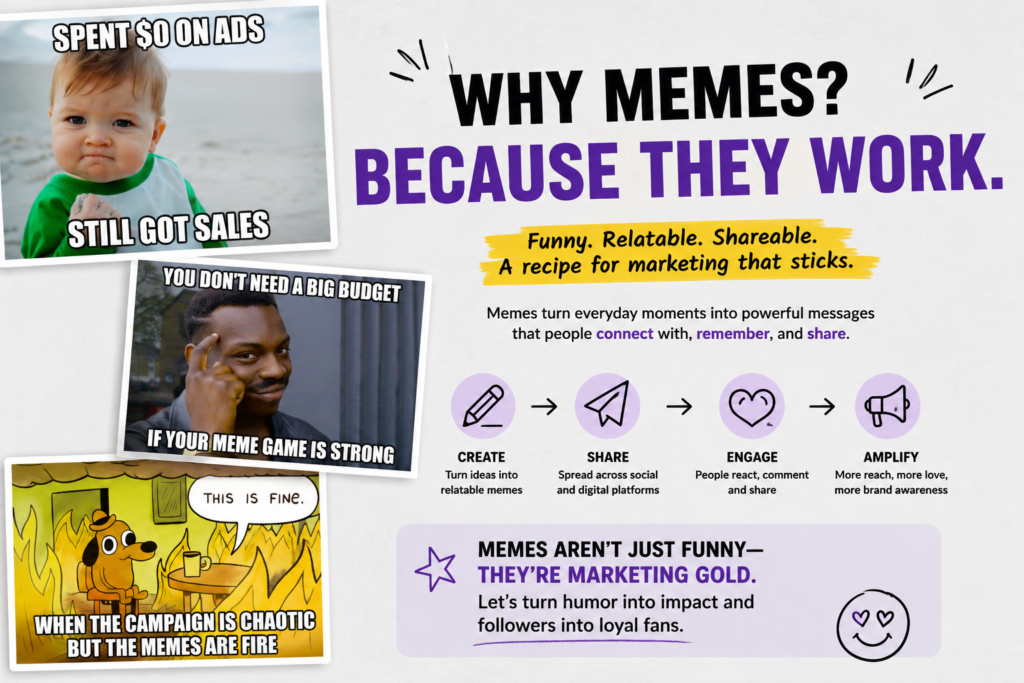
In 2024, a single meme posted by a fast‑food chain generated over 2 million engagements across social media platforms. Not a polished ad, not a celebrity endorsement – just a simple image with a few words. If you’ve ever looked at a viral post and muttered “what is this meme” while simultaneously chuckling, you’ve witnessed the raw power of modern internet culture.
Today, businesses aren’t just watching memes; they’re creating them. A well‑crafted meme can cut through the noise, humanise your brand, and spark conversations that paid ads can’t buy. In this guide, you’ll learn:
- What makes a meme recognisable and why the phrase “what is this meme” is the gateway to its viral nature.
- How to create your own memes from scratch using free and AI‑powered tools.
- A step‑by‑step meme marketing strategy that fits your brand without feeling forced.
- Legal pitfalls to avoid and metrics to prove your meme campaign’s value.
By the end, you’ll stop asking “what is this meme” and start answering with your own viral creations.
2. WHAT DOES “WHAT IS THIS MEME” MEAN? (THE MEME PHENOMENON EXPLAINED)
The phrase “what is this meme” is both a genuine question and a cultural inside joke. When someone stumbles across an unfamiliar image macro, GIF, or video format, they instinctively search “what is this meme” to learn its origin, meaning, and why it’s funny. This very search behaviour is why memes spread so quickly – curiosity fuels shares.
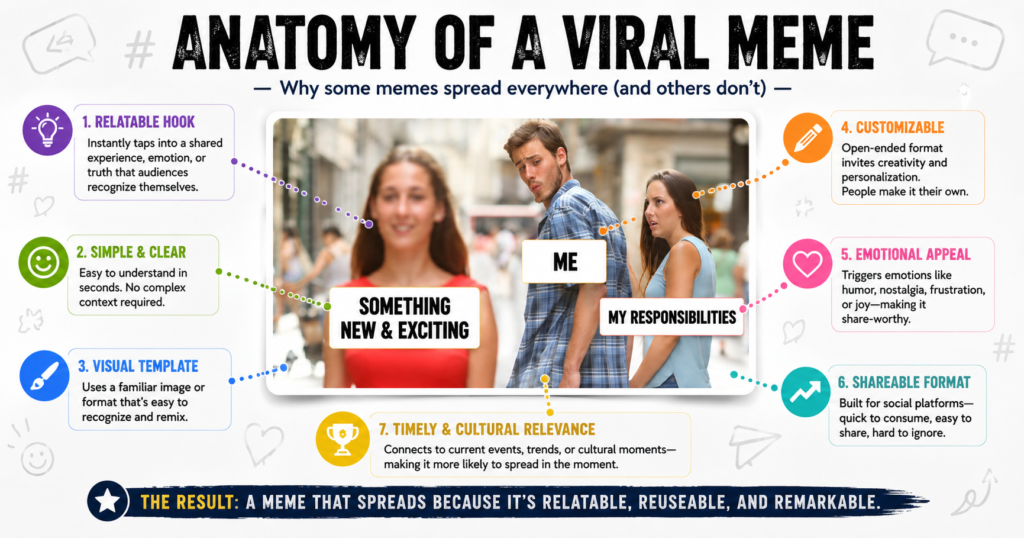
A meme is a unit of cultural information that spreads through imitation and variation. In the digital age, it’s usually a piece of media – a picture with bold text, a short video clip, or an animated GIF – that conveys an emotion, opinion, or joke within a shared reference frame. Memes evolve; the “Distracted Boyfriend” template, for example, has been adapted thousands of times to represent everything from career choices to software preferences.
For marketers, the value of understanding “what is this meme” is twofold:
- Trendspotting – knowing a meme’s original context lets you use it before it becomes stale.
- Relevance – audiences reward brands that get the joke.
3. WHY MEME MARKETING WORKS IN 2026 (AND HOW TO USE IT)
The average person sees 6,000 to 10,000 ads every day. Memes break through because they don’t feel like advertising. They entertain, resonate emotionally, and invite participation. Here’s why they’re especially potent in 2026:
- Shareability – A funny or relatable meme gets reposted, expanding your organic reach without spending a dollar on boosted posts.
- Brand personality – Memes show your business isn’t a faceless corporation; you’re in on the joke with your audience.
- Algorithm love – Platforms like Twitter/X, Instagram, and even LinkedIn now prioritise “conversation‑starting” content. Memes drive comments and reactions, boosting your visibility.
- Cost‑effectiveness – You can create a meme in under five minutes with free tools (we’ll cover them shortly).
How to use memes without looking cringe:
- Stay authentic. If your brand voice is serious, don’t force slapstick humour – a witty, industry‑relevant meme works better.
- React to real‑time events, but be sensitive.
- Always credit the template creator when possible.
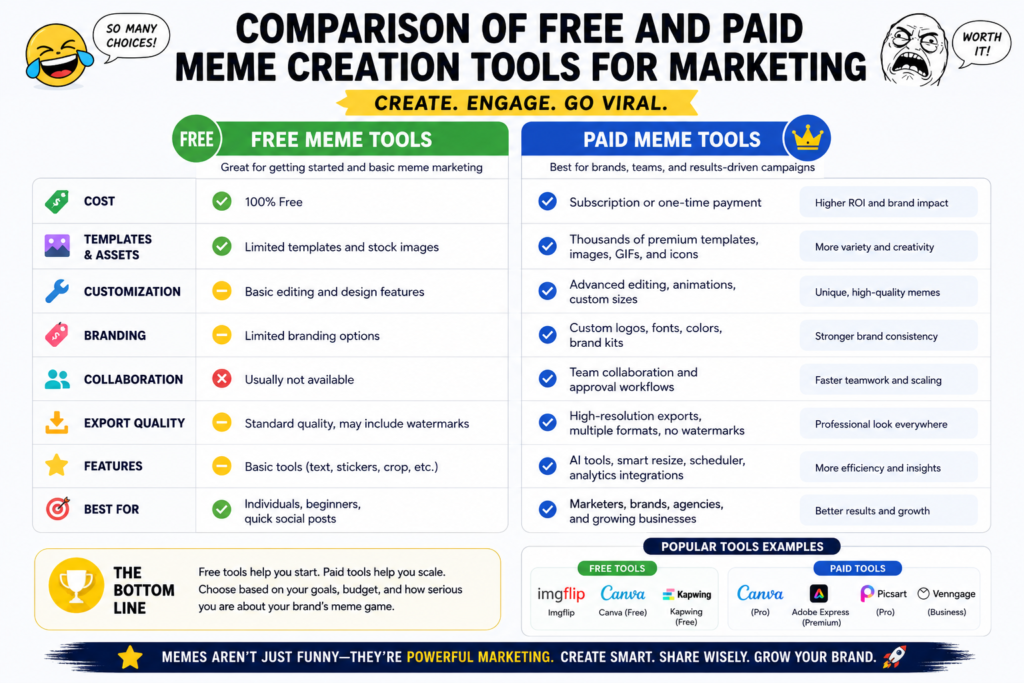
4. THE ULTIMATE MEME CREATION TOOLKIT: FREE & PAID TOOLS COMPARED
| Tool | Free? | Best For | Key Features | AI‑Powered? |
|---|---|---|---|---|
| Canva | Yes (pro for premium elements) | Beginners & marketers | Drag‑and‑drop editor, meme templates, brand kit | Some AI text generation |
| Adobe Express | Yes (basic) | Quick, professional designs | Pre‑sized meme templates, animation, Adobe Fonts | No |
| SmallSEOTools Meme Generator | Yes | Instant, no‑login memes | Classic meme templates, custom image upload, text formatting | No |
| SuperMeme AI | Freemium | AI‑generated creative concepts | Text‑to‑meme, 100+ languages, meme calendars | Yes |
| Kapwing | Freemium | Video/GIF memes | Timeline editor, subtitle tools, collaborative editing | Some AI features |
Our recommendation: Start with Canva or Adobe Express for polished static memes, SuperMeme AI for when you need 20 variations of the same joke, and SmallSEOTools for a lightning‑fast anonymous option.
5. HOW TO CREATE A MEME IN 6 STEPS (FROM BLANK TEMPLATE TO VIRAL POST)
(This section maps to the HowTo schema.)
Step 1 – Define your target audience and meme voice.
Who are you talking to? Gen‑Z loves surreal, self‑deprecating humour; professionals on LinkedIn respond to work‑life irony. Write down three adjectives that describe your brand’s tone (e.g., witty, helpful, rebellious). Every meme you create should align with at least two of them.
Step 2 – Find or capture a reusable meme template.
Visit a template library (Canva, SmallSEOTools, SuperMeme) and browse popular formats. Alternatively, screenshot a funny moment from a video, or use an AI image generator to create a custom visual. Make sure the template’s emotion matches your message – a “This Is Fine” dog won’t sell a motivational product.
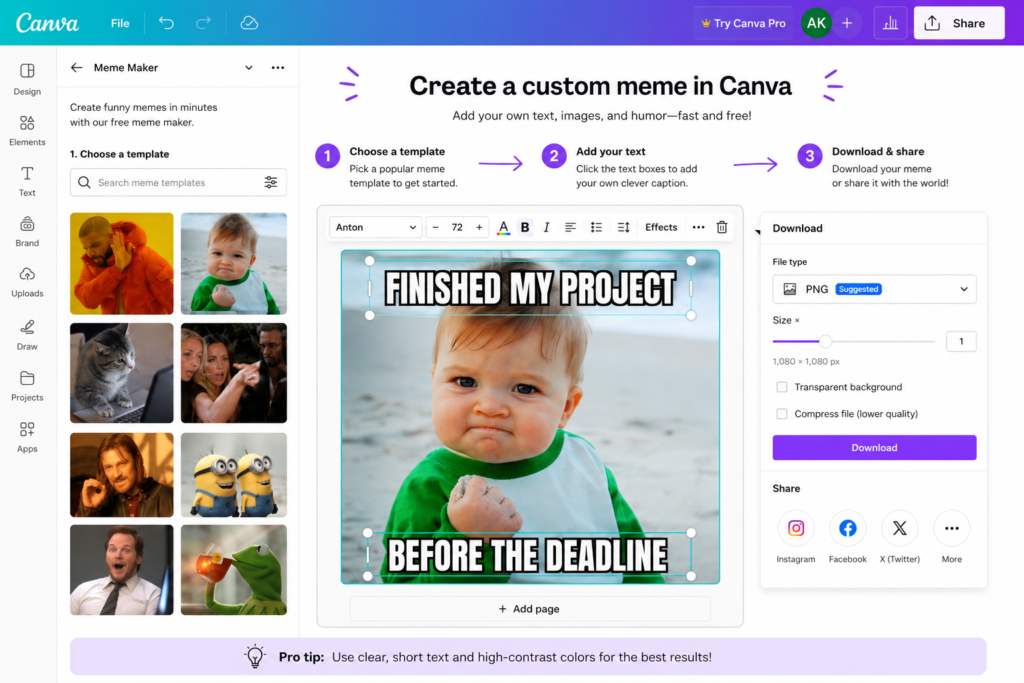
Step 3 – Add text and branding.
Keep text concise – the top line sets up the scenario, the bottom line delivers the punchline or call‑to‑action. Use Impact font for classic memes, or a clean sans‑serif for a modern look. Subtly add your logo or brand colours in a corner, but never overshadow the joke.
Step 4 – Use a meme generator or design tool to polish.
Upload your image to your chosen tool, place text boxes, adjust alignment, and experiment with white outlines (stroke) for readability. Most generators have a “Preview” option so you can see the final result before downloading.
Step 5 – Optimise for each social platform.
- Instagram/TikTok: 1080×1080 square or 1080×1920 vertical. Add hashtags like #memes, #marketinghumour.
- Twitter/X: 1200×675 horizontal. Keep the joke ultra‑short.
- Facebook/LinkedIn: 1200×630. LinkedIn memes often work better with a short caption above the image.
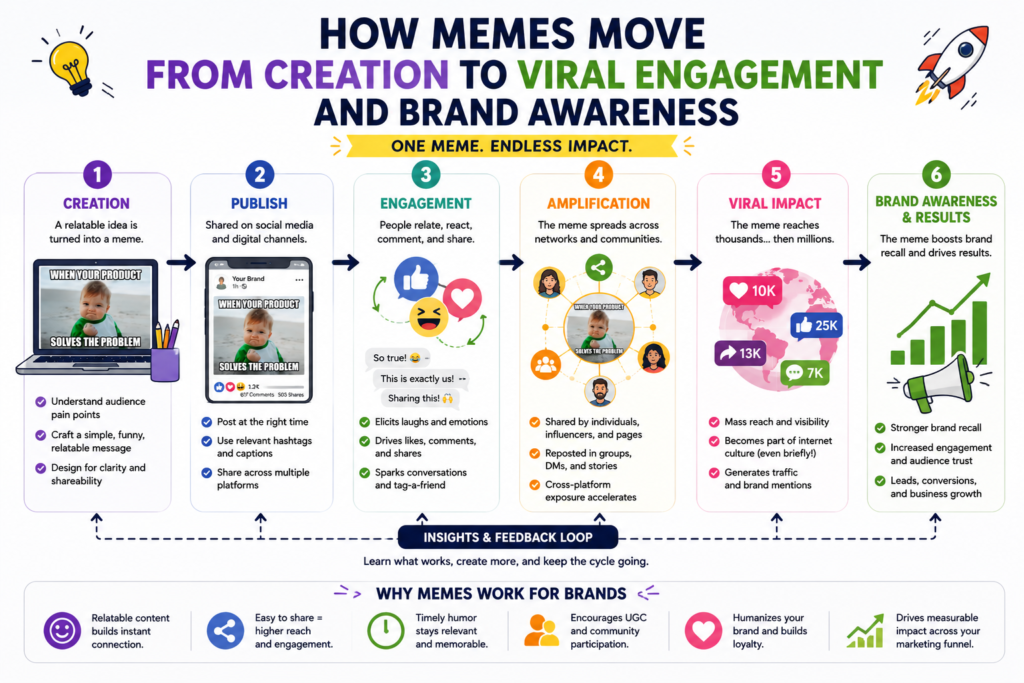
Step 6 – Post at peak times and track reactions.
Publish when your audience is most active (use your platform analytics). Monitor likes, shares, comments, and saves. A high share‑to‑like ratio indicates the meme resonated enough for someone to spread it – that’s your golden metric.

6. MEME MARKETING STRATEGY: WHEN, WHERE, AND HOW TO POST
When to post: Lunch hours (12–1 PM) and early evening (7–9 PM) local time are prime meme‑consumption windows. For Twitter, the evening wave often catches users doomscrolling.
Where to post:
- Instagram Stories – for raw, behind‑the‑scenes humour.
- Twitter – for real‑time reactions to news or trends.
- LinkedIn – for industry‑insider jokes (yes, professional memes exist and perform well).
- Reddit – only if you’re a genuine community member; Redditors hate blatant self‑promotion.
Frequency: 1–2 memes per week is a safe starting point. Too many, and your brand looks like it’s trying too hard; too few, and you miss the cultural moment.
Pillar approach: Create a content mix of original memes, curated (credited) memes, and reaction GIFs. This keeps your feed fresh without exhausting your creative team.
7. MEME COPYRIGHT & ETHICS: STAY OUT OF LEGAL TROUBLE
Memes often use copyrighted images (screenshots from movies, TV shows, stock photos). The legal landscape is murky, but here’s how to minimise risk:
- Fair use is not a universal shield. While many memes are considered transformative and thus protected under fair use, commercial use weakens that defence. If you’re using a meme in an ad campaign, get permission or use royalty‑free images. fair use guidelines
- Choose public‑domain or CC0 templates. Websites like Pixabay, Unsplash, and the dedicated meme template libraries on Canva/Adobe Express offer safe starting points.
- Avoid defamation. Don’t put words into a real person’s mouth unless they’re a public figure and the meme is clearly satirical.
- Credit creators when you can. This builds goodwill and keeps you ethically clean.
For absolute safety, create your own original meme images. AI tools like SuperMeme AI and DALL‑E can generate unique characters and scenes that become your own intellectual property.
8. MEASURING MEME SUCCESS: METRICS THAT ACTUALLY MATTER
Vanity metrics like likes are nice, but meme marketing should tie back to business goals. Track these KPIs:
- Engagement rate (likes + comments + shares / impressions). A rate above 5% is strong for memes.
- Share count – the ultimate organic amplifier.
- Follower growth – did the meme attract new followers?
- Click‑through rate – if your meme includes a link (e.g., “link in bio”), how many people followed through?
- Sentiment analysis – are the comments positive, or did the joke backfire? Manually scan the first 20 comments.
Use platform‑native analytics or a social media management tool like Buffer or Hootsuite to gather data. Compare meme posts against your standard content – you’ll likely see higher engagement and lower cost‑per‑impression.
9. FREQUENTLY ASKED QUESTIONS
1. What does “what is this meme” mean?
It’s the phrase people search when they encounter a meme they don’t recognise. It literally asks for the origin, format name, or context of the image or video. For marketers, it highlights the importance of tapping into well‑known, searchable meme formats.
2. How do I find the original source of a meme?
Use reverse image search tools like Google Images or TinEye. Upload the meme and look for the oldest indexed version. Sites like Know Your Meme also document meme origins and variations.
3. Are memes copyrighted?
Most memes use copyrighted source material, but their transformative nature often falls under fair use. However, using a meme for direct commercial advertising reduces that protection. To be safe, use royalty‑free templates or create original images.
4. What is the best free meme maker?
Canva and Adobe Express offer the most professional free meme templates with customisation options. For quick, anonymous creation, SmallSEOTools Meme Generator is excellent. SuperMeme AI provides AI‑powered text generation in the free tier.
5. Can I use memes for my business marketing?
Yes, many brands successfully use memes to humanise their voice and boost engagement. Stick to lighthearted, relatable humour that aligns with your brand identity, and always consider the legal and cultural sensitivity of the template.
6. How do I create a meme from scratch?
Start with a blank canvas in a design tool, add an image (your own photo, a royalty‑free stock image, or AI‑generated art), then overlay bold text top and bottom. Save in JPG or PNG format. The 6‑step process in Section 5 details each stage.
7. What makes a meme go viral?
Relatability, timing, and simplicity. Memes that capture a universal emotion or a trending news event spread fast. The best memes are easy to remix – giving others the template encourages more shares.
8. How often should I post memes for my brand?
Start with one or two per week on your primary social channel. Monitor engagement and adjust. Consistency matters more than frequency; a well‑timed meme once a week outperforms daily low‑effort posts.
9. Can AI generate good memes?
Yes, tools like SuperMeme AI and DALL‑E can generate both the visual and the caption. AI is especially useful for brainstorming multiple variations of the same joke. However, human oversight is still needed to ensure cultural relevance and avoid awkward misfires.
10. What are the most popular meme formats in 2026?
Classic formats like “Distracted Boyfriend,” “Woman Yelling at a Cat,” and “This Is Fine” still thrive. Newer AI‑generated characters and reaction GIFs from recent TV shows or games are also popular. Formats tied to ongoing viral events (e.g., a sports moment) can spike overnight.
10. CONCLUSION
Memes are no longer just internet jokes; they’re a legitimate, high‑impact marketing channel. By understanding what is this meme, you unlock the ability to join digital conversations your audience is already having. The tools are free, the creation process is quick, and the potential for organic reach is enormous.
Remember the six‑step framework: define your voice, choose or create a template, add crisp text, polish with a design tool, optimise for the platform, and track your results. Keep an eye on copyright, stay authentic, and don’t be afraid to experiment.
Bookmark this guide and refer back whenever you need a creative spark. For instant, no‑login meme creation, try our Free Meme Generator and start making your audience smile today.