

Here’s a stat that should grab your attention: According to Otterly.ai , ChatGPT alone receives over 2.5 billion prompts every single day from users around the world. And a growing chunk of those prompts? They’re coming from SEOs, bloggers, and content marketers trying to crack the keyword research code..
But here’s the thing most people get wrong. ChatGPT for keyword research isn’t about replacing your SEO tools. It’s about supercharging your brainstorming process so you can go from a blank page to a validated keyword list in minutes instead of hours.
In 2026, the smartest SEOs aren’t choosing between ChatGPT and Ahrefs. They’re using both — ChatGPT for idea generation, topic exploration, and clustering and traditional tools for validation, volume data, and difficulty scoring.
In this guide, I’ll show you exactly how to use ChatGPT for keyword research, including:
- 15 copy-paste prompts you can use immediately
- A 7-step workflow from seed keyword to validated list
- How to cluster keywords and map search intent with AI
- Common mistakes to avoid (and how to fix them)
- How to validate ChatGPT keywords with free SEO tools
SECTION 2 — WHAT CHATGPT CAN AND CANNOT DO FOR KEYWORD RESEARCH

Before we dive into the prompts, let’s get one thing crystal clear.
What ChatGPT CAN Do
ChatGPT is exceptional at:
- Brainstorming seed keywords from a broad topic
- Expanding keywords into long-tail variations
- Grouping and clustering keywords by theme
- Identifying subtopics and content angles you might have missed
- Generating question-based keywords (who, what, why, when, how)
- Analyzing search intent patterns for keyword groups
- Creating content briefs from keyword clusters
According to INSIDEA , ChatGPT’s strength in these areas particularly semantic keyword expansion and topic clustering — makes it a powerful brainstorming partner for SEOs.
What ChatGPT CANNOT Do
And here’s where the caution tape goes up. ChatGPT on its own is NOT a keyword research tool-1. It’s a language model. Here’s what it cannot do:
- Provide accurate search volume data — it doesn’t have real-time access to Google’s data-41
- Calculate keyword difficulty — it has no idea how competitive a keyword actually is
- Show CPC (cost per click) — that’s ad platform data, not language model data
- Guarantee a keyword exists — ChatGPT can hallucinate and invent keywords that nobody has ever searched for-40
- Replace validation — every single keyword ChatGPT gives you needs to be verified in a real SEO too
As noted in ClickUp’s analysis , ChatGPT scores poorly on tasks requiring real-time data access and struggles with providing accurate keyword difficulty scores — which is exactly why validation is non-negotiable.l
The Golden Rule: Use ChatGPT for inspiration and organization. Use Ahrefs, Semrush, Ubersuggest, or Google Keyword Planner for validation and data-1.
SECTION 3 — HOW TO GENERATE SEED KEYWORDS WITH CHATGPT
This is where the magic starts. Seed keywords are the foundation of your entire keyword research process — broad terms that define your niche or topic.
As ClickRank.ai explains, the conversational nature of ChatGPT makes it uniquely suited for back-and-forth keyword exploration — you can keep refining your prompts until you uncover the exact seed keywords you need.
Step 1: Define Your Core Topic
Before you open ChatGPT, know your core topic. For this guide, let’s use “content marketing for SaaS” as our example.
Step 2: Use the “Popular Subtopic” Prompt
This is your starting prompt:
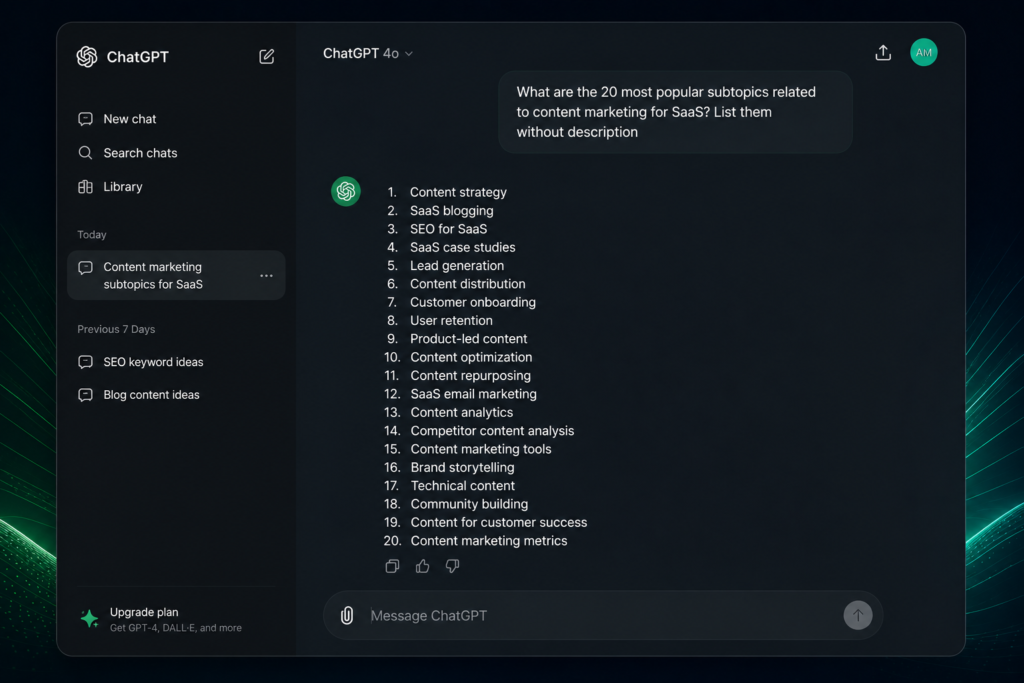
Prompt 1: “What are the 20 most popular subtopics related to [YOUR TOPIC]? List them without description.”
Example: “What are the 20 most popular subtopics related to content marketing for SaaS? List them without description.”
ChatGPT will return a list like: SaaS content strategy, B2B blog writing, case study marketing, thought leadership content, product-led content, SEO for SaaS, email marketing for SaaS, etc.
Step 3: Drill Deeper with the “Sub-Subtopic” Prompt
Take one subtopic and go deeper:
Prompt 2: “What are the 15 most popular subtopics related to [SUBSET]? List them without description.”
Example: “What are the 15 most popular subtopics related to SEO for SaaS? List them without description.”
Now you’re building a topic tree. This is how you uncover keyword opportunities you would have never thought of on your own-40.
SECTION 4 — HOW TO EXPAND SEED KEYWORDS INTO LONG-TAIL VARIATIONS
Once you have your seed keywords, it’s time to expand them into long-tail variations. Long-tail keywords are 3+ word phrases with lower competition and higher conversion intent.

The Long-Tail Expansion Prompt
Prompt 3: “Generate 30 long-tail keyword variations for [SEED KEYWORD]. Include question-based, comparison-based, and intent-based variations.”
Example: “Generate 30 long-tail keyword variations for ‘SaaS content marketing.’ Include question-based, comparison-based, and intent-based variations.”
The Question-Based Keyword Prompt
Question-based keywords are goldmines for featured snippets:
Prompt 4: “Generate 20 question-based keywords for [TOPIC] starting with who, what, why, when, where, and how.”
Example: “Generate 20 question-based keywords for ‘SaaS content marketing’ starting with who, what, why, when, where, and how.”
The “People Also Ask” Style Prompt
Prompt 5: “What are the most common questions people ask about [TOPIC]? Generate a list of 25 questions.”
This mimics Google’s “People Also Ask” feature and helps you uncover real user intent-40.
SECTION 5 — HOW TO USE CHATGPT FOR KEYWORD CLUSTERING AND GROUPING
Now you have dozens (or hundreds) of keywords. But a messy list is useless. You need to cluster them — group related keywords together so you can plan content that covers multiple related terms.

The Keyword Clustering Prompt
Prompt 6: “Here is a list of keywords: [PASTE YOUR LIST]. Group these keywords into 5–7 clusters based on topic and search intent. Name each cluster and list the keywords under each.”
ChatGPT will organize your keywords into logical groups like:
- Cluster 1: SaaS Content Strategy — SaaS content strategy, B2B content marketing plan, content calendar for SaaS
- Cluster 2: SEO for SaaS — SaaS SEO strategy, SEO for B2B SaaS, technical SEO for SaaS
- Cluster 3: SaaS Blog Writing — SaaS blog topics, B2B blog writing tips, SaaS case study writing
Why Clustering Matters
Clustering helps you:
- Plan pillar content that covers entire topic groups
- Avoid keyword cannibalization (multiple pages targeting the same keyword)
- Build topic clusters that signal authority to Google
- Create content that ranks for 10+ keywords instead of just one
SECTION 6 — HOW TO ANALYZE SEARCH INTENT WITH CHATGPT
Not all keywords are created equal. A keyword’s search intent — what the user actually wants when they search — determines what kind of content you should create.
The Four Types of Search Intent

| Intent Type | What the User Wants | Content Format |
|---|---|---|
| Informational | To learn something | Blog posts, guides, tutorials |
| Navigational | To find a specific site or page | Homepage, brand pages |
| Commercial | To research before buying | Comparison posts, reviews, case studies |
| Transactional | To make a purchase | Product pages, pricing pages, demos |
The Intent Analysis Prompt
Prompt 7: “For each keyword in this list: [PASTE KEYWORDS], classify the search intent as Informational, Navigational, Commercial, or Transactional. Explain why for each.”
This helps you match content formats to user expectations — which is exactly what Google rewards.
The Content Angle Prompt
Once you know the intent:
Prompt 8: “For the Commercial Intent keywords in this list: [PASTE KEYWORDS], suggest 5 content angles or headlines that would satisfy this intent.”
SECTION 7 — HOW TO VALIDATE CHATGPT KEYWORDS WITH FREE SEO TOOLS
This is the most important section of this guide. Never trust ChatGPT keywords without validation-1.
Here’s your validation workflow:

Step 1: Export Your ChatGPT Keywords
Copy your final keyword list from ChatGPT into a spreadsheet or text file.
Step 2: Run Through Ubersuggest (Free)
Ubersuggest’s free tier gives you:
- Search volume data
- Keyword difficulty scores
- CPC data
- Related keyword suggestions
How to use: Paste your keywords one by one or in small batches. Look for keywords with:
- Search volume: 100–1,000+ (depending on your niche)
- Keyword difficulty: Under 30 (for new websites)-1
- CPC: Optional, but higher CPC often means higher commercial value
Step 3: Run Through Google Keyword Planner (Free)
Google keyword planner google’s own tool (requires a Google Ads account, but you don’t need to spend money):
- Provides accurate search volume directly from Google
- Shows competition level (low, medium, high)
- Gives bid estimates (proxy for commercial value)
Step 4: Check SERP Competition Manually
Type your keyword into Google. Look at the first page:
- Are there forums and Quora posts? Good sign — easier to rank.
- Are there industry giants (HubSpot, Moz, Ahrefs)? Harder to rank.
- Are there low-authority blogs? Great opportunity.
The “Easy Keyword” Rule
Target keywords with a difficulty score lower than your Domain Rating (DR) -1. If your DR is 20, target keywords with KD under 20. If your DR is 50, you can target KD under 50.
Pro Tip: A keyword with 70 monthly searches and a KD of 10 is often more valuable than a keyword with 1,000 monthly searches and a KD of 70. The first one is practically free traffic-1.
SECTION 8 — THE BEST CHATGPT PROMPTS FOR KEYWORD RESEARCH
Here’s your complete copy-paste prompt library. Save these.
Prompt 1: Seed Keyword Generation
“What are the 20 most popular subtopics related to [YOUR TOPIC]? List them without description.”
Prompt 2: Deep Dive Subtopics
“What are the 15 most popular subtopics related to [SUBSET]? List them without description.”
Prompt 3: Long-Tail Expansion
“Generate 30 long-tail keyword variations for [SEED KEYWORD]. Include question-based, comparison-based, and intent-based variations.”
Prompt 4: Question-Based Keywords
“Generate 20 question-based keywords for [TOPIC] starting with who, what, why, when, where, and how.”
Prompt 5: People Also Ask Style
“What are the most common questions people ask about [TOPIC]? Generate a list of 25 questions.”
Prompt 6: Keyword Clustering
“Here is a list of keywords: [PASTE LIST]. Group these keywords into 5–7 clusters based on topic and search intent. Name each cluster and list the keywords under each.”
Prompt 7: Search Intent Classification
“For each keyword in this list: [PASTE KEYWORDS], classify the search intent as Informational, Navigational, Commercial, or Transactional. Explain why for each.”
Prompt 8: Content Angle Ideas
“For the Commercial Intent keywords in this list: [PASTE KEYWORDS], suggest 5 content angles or headlines that would satisfy this intent.”
Prompt 9: Competitor Keyword Gap
“My competitors are [COMPETITOR 1], [COMPETITOR 2], and [COMPETITOR 3] in the [NICHE] space. What keywords might they be targeting that I’m missing? Generate 20 potential keywords.”
Prompt 10: Content Brief from Keywords
“Based on this keyword cluster: [PASTE CLUSTER], create a content brief including: target audience, content angle, key points to cover, suggested headings, and FAQ questions.”
Prompt 11: “List Without Description” (Clean Output)
“List without description the top 25 most popular keywords for [TOPIC].” -40
Prompt 12: “Fan-Out” Query Exploration
“If someone searched for [KEYWORD], what related queries would ChatGPT ‘fan out’ to in order to answer that search? Generate 15 related queries.” –
Prompt 13: Low-Competition Keyword Focus
“Generate 25 low-competition, long-tail keywords for [TOPIC] that a new website could realistically rank for. Focus on specific, niche phrases.”
Prompt 14: Seasonal/Trending Keywords
“What are the trending keywords and subtopics for [TOPIC] in [CURRENT YEAR]? Generate 15 suggestions.”
Prompt 15: Content Gap Analysis
“I’ve written about [TOPICS YOU’VE COVERED]. What are 10 keyword opportunities I’m missing in the [NICHE] space?”
SECTION 9 — COMMON MISTAKES TO AVOID
Mistake 1: Treating ChatGPT as a Keyword Research Tool
The Problem: Using ChatGPT as your only tool and publishing content based on unvalidated keywords.
The Fix: ChatGPT is for idea generation-1. Always validate with Ubersuggest, Google Keyword Planner, or Ahrefs.
As SEO expert Stevy Liakopoulou correctly puts it, keyword research in 2026 is goals plus seed topics minus real data — meaning ChatGPT is the ‘goals and seeds’ part, but the ‘real data’ must come from elsewhere.
And the data backs this approach up — according to Erlin.ai , AI-sourced traffic has grown 527% year-over-year, making it essential to use ChatGPT correctly rather than treating it as a standalone solution.
Mistake 2: Ignoring Keyword Difficulty
The Problem: Targeting high-difficulty keywords that you’ll never rank for.
The Fix: Only target keywords with a difficulty score lower than your Domain Rating-1.
Mistake 3: Not Verifying Search Volume
The Problem: ChatGPT can invent keywords that have zero search volume-40.
The Fix: Always check search volume in a real tool before investing time in content.
Mistake 4: Skipping Search Intent Analysis
The Problem: Writing a blog post for a keyword with transactional intent (users want to buy, not read).
The Fix: Always classify intent and match your content format accordingly.
Mistake 5: Overlooking Long-Tail Keywords
The Problem: Only targeting head terms (1–2 words) that are incredibly competitive.
The Fix: Long-tail keywords (3+ words) have lower competition and higher conversion rates. Use Prompt 3 to generate them.
Mistake 6: Not Clustering Keywords
The Problem: Writing separate articles for keywords that should be grouped together, wasting content opportunities.
The Fix: Cluster keywords and create pillar content that covers an entire topic cluster-41.
SECTION 10 — FAQ
1. Can ChatGPT do keyword research?
Yes, but only for the brainstorming and organization phase. ChatGPT cannot provide accurate search volume, keyword difficulty, or CPC data. It generates ideas that you must validate with proper SEO tools-1.
2. Is ChatGPT good for keyword research?
ChatGPT is excellent for generating seed keywords, expanding long-tail variations, and clustering keywords by topic. However, it is not good at providing accurate metrics or validating whether a keyword is worth targeting-40.
3. How do I use ChatGPT for keyword research?
Start by defining your core topic, then use prompts to generate subtopics, expand into long-tail keywords, cluster them, and classify search intent. Always export your list and validate with free tools like Ubersuggest or Google Keyword Planner.
4. What are the best ChatGPT prompts for keyword research?
The 15 prompts listed in Section 8 of this guide cover everything from seed generation to competitor gap analysis. The most essential ones are the subtopic prompt, long-tail expansion prompt, and keyword clustering prompt.
5. Can ChatGPT replace Ahrefs or Semrush for keyword research?
No. ChatGPT cannot replace dedicated SEO tools because it lacks access to real search data, volume metrics, and difficulty scores-41. Think of ChatGPT as your brainstorming partner and Ahrefs/Semrush as your data source.
6. Does ChatGPT provide accurate search volume data?
No. ChatGPT does not have real-time access to Google’s search data-41. It may guess or hallucinate numbers. Always verify search volume using Google Keyword Planner, Ubersuggest, or Ahrefs.
7. How do I validate keywords from ChatGPT?
Export your ChatGPT keywords and run them through Ubersuggest (free), Google Keyword Planner (free), or Ahrefs (paid). Check search volume, keyword difficulty, and SERP competition. Only target keywords with a difficulty score lower than your Domain Rating-1.
8. What are the limitations of using ChatGPT for keyword research?
ChatGPT cannot access real-time search data, calculate keyword difficulty, provide accurate search volume, or guarantee a keyword exists. It can also hallucinate and invent keywords that nobody has ever searched for-40.
9. Can ChatGPT help with long-tail keyword research?
Yes. ChatGPT is excellent at generating long-tail keyword variations. Use Prompt 3: “Generate 30 long-tail keyword variations for [SEED KEYWORD]. Include question-based, comparison-based, and intent-based variations.”
10. How do I use ChatGPT for competitor keyword analysis?
Use Prompt 9: “My competitors are [COMPETITOR 1], [COMPETITOR 2], and [COMPETITOR 3] in the [NICHE] space. What keywords might they be targeting that I’m missing? Generate 20 potential keywords.” Then validate the suggestions with SEO tools.
SECTION 11 — CONCLUSION
Here’s the bottom line on ChatGPT for keyword research in 2026.
ChatGPT is not a replacement for Ahrefs, Semrush, or Google Keyword Planner. It never will be. But it is one of the most powerful brainstorming tools you can add to your SEO workflow.
The smartest SEOs are using ChatGPT to:
- Generate seed keywords in seconds
- Expand into long-tail variations they would have missed
- Cluster keywords into content pillars
- Classify search intent at scale
- Create content briefs from keyword clusters
And then they’re validating everything with real SEO tools.
Your 7-step workflow:
- Define your core topic
- Generate seed keywords (Prompt 1)
- Expand into long-tail variations (Prompt 3)
- Cluster keywords by topic (Prompt 6)
- Classify search intent (Prompt 7)
- Validate with free tools (Ubersuggest / Google Keyword Planner)
- Filter by difficulty and create your content plan
Bookmark this guide. Every time you start a new content project, run through this workflow. It will save you hours of staring at a blank page and send you straight into high-impact content creation.
Ready to take your keyword research further? Check out our Best Free Keyword Research Tools guide for more validation options, or dive into our Long-Tail Keyword Strategy to learn how to target the keywords that actually convert.
Now go generate some keywords. And remember — validate before you publish.